
Education
How to become an aesthetic practitioner
With an estimated worth of over £3 billion in the UK alone, the growing aesthetics industry has the potential to offer healthcare professionals a lucrative and exciting career. That’s why many healthcare professionals are now considering a career in medical aesthetics.
The chance to forge a lucrative new career path as well as greater professional autonomy are two commonly cited motivations behind the upsurge in healthcare professionals considering a move into aesthetic practice. Within the NHS, doctors, dentists, nurses, pharmacists, paramedics and other allied healthcare professionals undergo a rigorous and well-structured regulated training that allows them to progress within a clear pathway. While such training is indispensable for a safe and successful career in the facial aesthetics field, the move into the private sector can be fraught with challenges, not least in regard to training and qualifications.
A successful career in the competitive field of medical aesthetics requires excellent training, good business decision-making and a patient-centred approach.
With an estimated worth of over £3 billion in the UK alone, the growing aesthetics industry has the potential to offer healthcare professionals a lucrative and exciting career. That’s why many healthcare professionals are now considering a career in medical aesthetics.
How to become an aesthetic practitioner in the United Kingdom?
Start your aesthetics career the right way
Choosing the right aesthetics training provider
Aesthetic medicine continues to offer exciting opportunities to healthcare professionals looking to diversify their skill set or start a completely new career as aesthetic practitioners. The training that practitioners undertake is fundamental to determining how successful this new career option is.
The quality of training provided varies wildly in the UK. Normally, aesthetics courses, like the JCCP-approved Level 7 Diploma in Aesthetics, which offer excellent training, in-depth anatomy knowledge and an online platform with video tutorials and great support, have a price tag. Some of the training providers like Interface Aesthetics offer exclusive discounts for BCAM members. It’s really important to research a training course provided by experts who are there to support you during and after the training. The structure of the course and its regulation also play a huge role in the decision process.
Making the right choice early on will be both financially and professionally beneficial in the medium to long term, and with moves towards greater regulation afoot in the UK, choosing a training provider that offers OFQUAL-regulated courses that are both nationally and internationally accredited together with a hands-on approach delivered by an expert faculty of trainers has never been more important.
Courses can be expensive, and, as such, choosing the right training provider is a significant decision, which, if done well, can represent an excellent investment. Training courses are an opportunity to learn from others, practise under supervision and receive feedback in a safe and supportive setting.
Some important points to address, when choosing the best aesthetics training provider, include:
- Is the course academically accredited, such as the VTCT Level 7 Diploma provided by Interface Aesthetics, or is it a non-regulated CPD-accredited short course?
- Is the Level 7 Diploma approved by the JCCP (Joint Council for Cosmetic Practitioners), offering the highest level of external quality assurance and future-proofing for regulatory changes?
- Is the training hands-on, using real patients?
- Is the aesthetics training centre offering small class sizes?
- Who designs and delivers the training?
- Is the training recognised by insurers – enabling you to practise upon completion?
- What training products will be used on the course?
- What support is provided before, during, and after the course?
- How is the feedback from previous delegates?
The ability to learn and practise the taught techniques should be a top priority when selecting a course on non-surgical aesthetics. This includes both the qualifications and expertise of the instructors, as well as the opportunity for hands-on training. Make sure you make an informed decision before choosing your training provider.
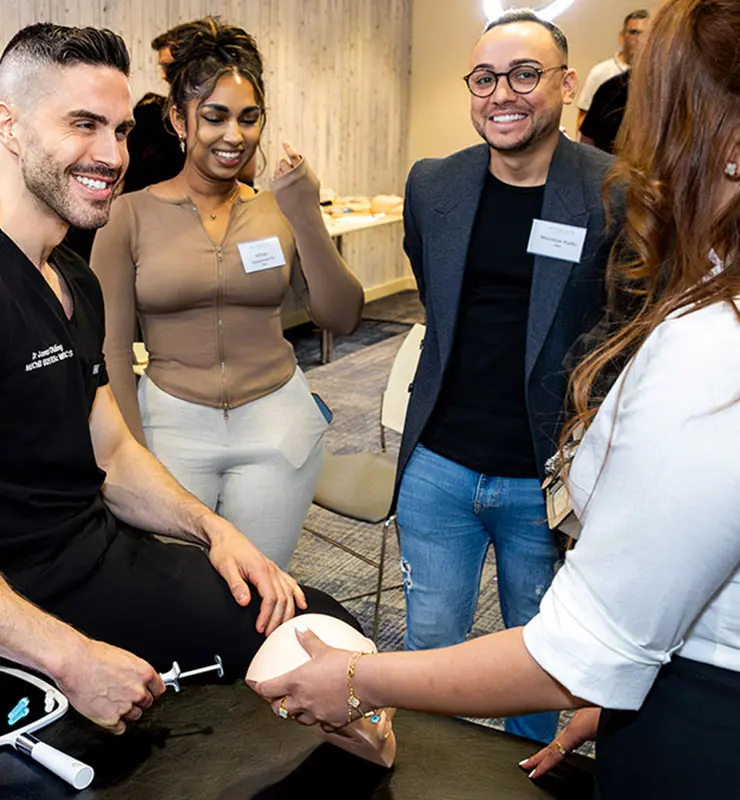
Hands-on practical training
Injectables courses should provide both theoretical and practical training, equipping aesthetic practitioners with the knowledge and skills to move into independent practice safely.
As in any area of healthcare, competency in a skill requires knowledge, skill and experience. Training in injectables is no different, and to get the most from your course, it must be geared towards enabling the maximum opportunity to practise on patients – real patients. Courses that focus most or a large part of the time on classroom-based theoretical learning will not give you the confidence you require to move into independent practice.
The top priority, when selecting an aesthetics course, is to understand how the experts will train you and who will train you. Is the faculty of trainers used to provide courses for HCPs like you? Will anatomy, ethics, patient communication, complications and pharmacology be mentioned during the JCCP-approved Level 7 Diploma in Aesthetics?
While theoretical understanding of important concepts is crucial, the key objective of any delegate attending a course must be getting comfortable assessing and treating patients.
Choosing a course that places experiential learning over classroom lectures and simulated teaching is fundamental to coming away with the confidence needed to begin independent working.
Aesthetics courses need to be patient-focused, with training centred on developing delegates to assess and deliver treatments confidently to their patients. The use of mannequins cannot compare to examining and treating real patients – such training will not build the confidence required to embark on practice after the course. That’s why the JCCP-approved postgraduate Level 7 Diploma in Aesthetics is the best course for HCPs.
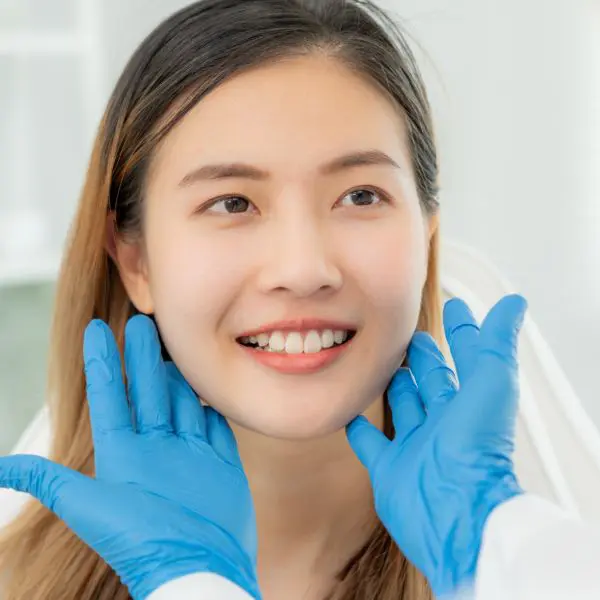
When performing aesthetic injectable treatments, the practitioner’s objective is to achieve safe, natural, and patient-appropriate outcomes. This requires a holistic approach to facial assessment rather than focusing solely on isolated treatment areas. A comprehensive consultation should include evaluation of the patient’s dynamic facial expressions, an analysis of facial proportions and geometry, and an open discussion regarding the patient’s expectations, motivations, and treatment goals.
Adopting this patient-centred approach from the outset of training is essential for responsible aesthetic practice. Practitioners must balance patient expectations with clinical judgement, prioritising safety and evidence-based decision making at all stages of treatment planning and delivery.
Competent practice in aesthetic medicine relies on a strong foundation of anatomical knowledge, clinical assessment skills, and technical competence. These competencies are developed through the practitioner’s original qualification as a healthcare professional, combined with structured education and supervised training in medical aesthetics.
Small training groups
Choosing a training provider which offers a low student-to-trainer ratio is vital to ensure you get the hands-on training necessary to build your confidence. Demonstrations in large groups, with little to no hands-on injecting, will often leave delegates lacking in experience and confidence following a course – it is not uncommon for Interface Aesthetics to train delegates who have come to repeat a course after a poor previous experience with another training provider taught in a large group.
In a small teaching group, you’ll receive crucial feedback on your injecting technique, as well as having a greater opportunity to assess and interact with live patients. Getting into the habit of assessing a patient systematically will pay dividends upon commencing independent practice, and a small group environment is fundamental to being able to practise this during training.
Small cohorts also enable future aesthetic practitioners to bond easily and support each other. This is very important because you can then start your support network while attending courses and conferences. In addition, small groups enable better interaction with the expert trainers: this is extremely valuable. These settings create organic exchanges of experience and skills; this is where you start building your network.
Studying alongside aesthetics courses
When choosing a training provider for becoming an aesthetic practitioner, many students require to be able to work or study alongside the courses. Not all aesthetic training providers allow delegates to study while following an injectables course; their schedule options are not flexible.
To guarantee the best outcome for your new career, make sure to select a training provider that schedules hands-on courses or mentorship days based on your availability. Some training academies are more flexible than others.
For instance, at Interface Aesthetics, when you choose an OFQUAL-regulated course that requires you to attend multiple days (such as the JCCP-approved postgraduate Level 7 Diploma in Aesthetics), be reassured that there is flexibility around attending days. For one-day courses, you can pick the day that suits you best among the many options available. You can find the next training sessions on each one-day course page. For instance, you can find the upcoming dates for the Foundation Botox and Fillers Course for HCPs by clicking the link.

CPD accreditation
Before training as an aesthetic practitioner, double-check if the training provider is a CPD member and if their courses are CPD accredited. CPD accredited courses undergo a quality assessment, which means a third party assessed and approved the courses.
In addition, it means that you will gain CPD points by attending such courses; these points can be used for the renewal of your professional registration with your professional governing body.
Experience and expertise of the Faculty of trainers
Before joining any aesthetic training, it’s important that you ask the training academy you selected who will train you.
- Who will be the trainer?
- Can I find information about them on your website?
- What are their backgrounds?
- How long have they been practising in the aesthetics industry?
- What are their areas of expertise?
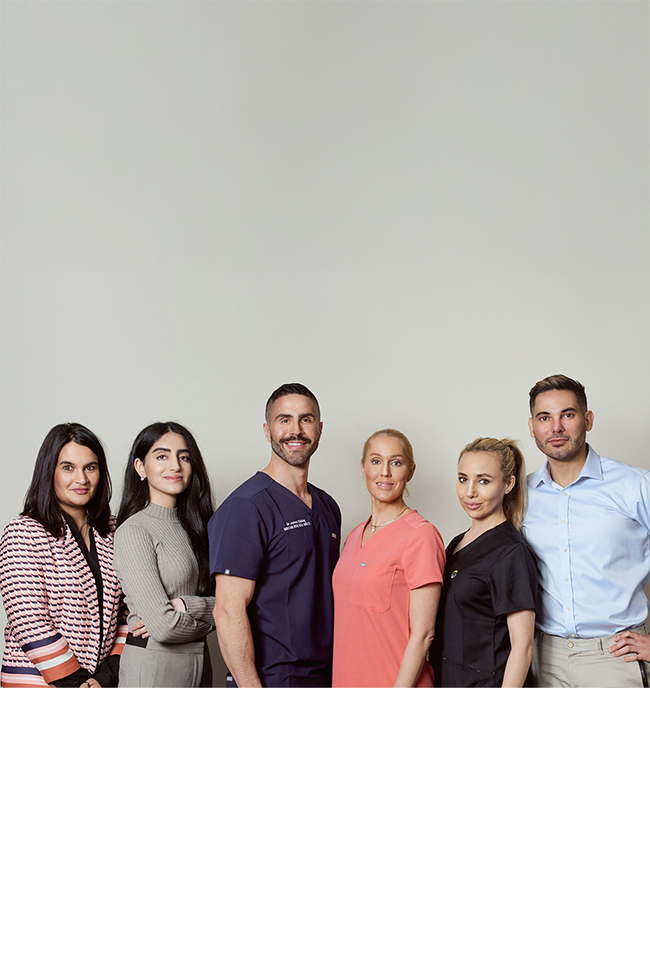
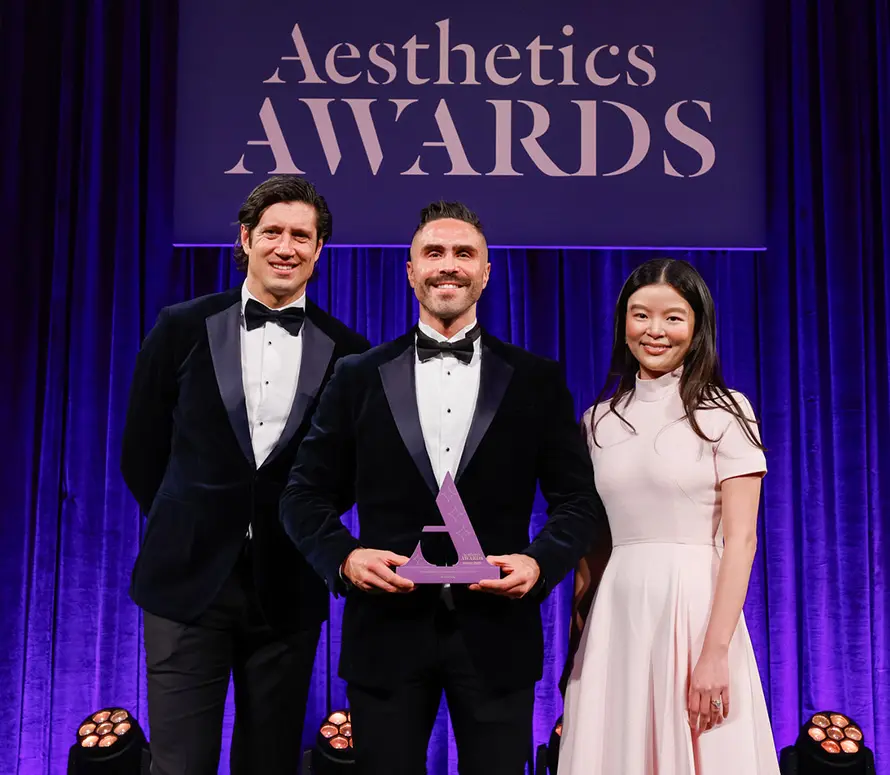
For instance, at Interface Aesthetics, courses are led by the UK’s leading aesthetic practitioners; most of the trainers received several prizes for their work in the industry: Mr James Olding was awarded Medical Aesthetics Practitioner of the Year at the 2025 Aesthetics Awards, Julie Scott won the title of Nurse of the Year in 2022 and 2024 at the Aesthetic Award, and Nurse of the Year 2024 by Aesthetic Medicine.
Aesthetics training and insurance
One of the most important questions to ask aesthetics training providers is: are your qualifications recognised by insurers?
It’s mandatory that you follow courses recognised by medical insurance companies if you want to practise aesthetic medicine upon completion of a course.
Support
By undertaking an academically accredited qualification under guidance, you will be engaged in a prolonged learning process with both patients and aesthetic mentors. The value of repeated face-to-face sessions to practise injecting and clinical skills is great, and being part of an aesthetic mentorship programme gives you access to expert aesthetics injectors both during and after your period of study.
Feedback can be actively sought, techniques can be practised, and repeated, and theoretical concepts can be discussed and debated at length. This creates a truly optimal environment for learning and training, providing the safety and reassurance of having an experienced aesthetics injector accompanying you at every step of your career.
But support is also important before undertaking a course: some training providers, such as Interface Aesthetics, offer interest-free payment plans for delegates who want to apply for the JCCP-approved Level 7 Diploma in Injectables. Joining courses to become an aesthetic practitioner is an investment, and Interface Aesthetics is here to help you start your aesthetics career the right way.

Choosing the right course for your career
There is a wide range of training courses available in the UK, and healthcare professionals looking to break into the field of non-surgical aesthetics can often be left with questions regarding which course could be right for them. Some important differences exist between both the training providers and the nature of the courses offered, and it is important that prospective delegates are sufficiently informed in order to make the correct choice.
Before embarking on training, it is important that you get all of the information necessary to make the right decision. Training can be expensive, but choosing a course that provides the knowledge, practical experience and confidence you need to establish a safe and successful practice will pay dividends in the medium to long term.
The top points to consider are:
- Be confident that you will be trained in a small group, with hands-on training with real model patients. Training in a classroom setting or injecting using mannequins will not provide the confidence and experience necessary.
- Be confident in the quality of the training, including the credentials of the trainers and reviews from previous delegates. At Interface Aesthetics, we strongly believe that a detailed understanding of facial anatomy as well as experience in dealing with complications are prerequisites for any aesthetic trainer.
- Make an informed decision regarding nationally regulated and accredited qualifications versus non-regulated qualifications. Regulated qualifications, such as the JCCP-approved Level 7 Diploma in Injectables, are more expensive, but in an industry which is moving towards greater regulation, these courses may be the right for you in terms of long-term employability and gaining greater confidence under expert supervision.
As a healthcare professional, it is important that you choose the right course for your needs and objectives, and that, crucially, your decision is informed. When it is considered that the majority of individuals undertaking non-surgical aesthetic courses do not go on to use their skills, the importance of choosing the right course becomes even more apparent.
The multitude of training options on offer can be confusing; getting into the detail of what a course will involve, the investment required and the likely return on any such investment are fundamental to making the right choice about your training and qualifications.
The JCCP-approved Level 7 Diploma in Injectables is the most important qualification for those beginning their journey in aesthetics. However, depending on individual circumstances and experience, many practitioners also start with one-day courses, such as:
- Foundation Botox and Dermal Fillers Course
- Advanced Toxin and Cannula Course
- Complications Management Masterclass
- Skin Boosters Course
- Biostimulator Masterclass
These one-day courses can provide valuable skills and confidence, but the JCCP-approved Level 7 qualification remains the gold standard for comprehensive training, mentorship, and hands-on experience.
Here are some of the most popular entry routes when it comes to training as an aesthetic practitioner in the UK or in a country where these qualifications are recognised:
Foundation Botox and Dermal Fillers course
A Foundation course is one option for any healthcare professionals looking to start out in the aesthetic field, or you can take part in the JCCP-approved Level 7 Diploma in Aesthetics. The one-day course is the first step, as part of the JCCP-approved Level 7 Diploma, or it can be taken stand-alone. The Foundation Course in Botox and Dermal Fillers has the following key features:
- Learn to perform the basics of licensed anti-wrinkle treatments in the upper face and an introduction to dermal fillers techniques.
- Training designed and delivered by experienced practitioners who are Registered Healthcare Professionals with a strong emphasis in patient safety and a background in Facial Surgery.
- Guaranteed small group training.
- Hands-on training with live model patients.
- Training dedicated for a safe delivery of treatments, including the management of complications.
- Practical emphasis, with 80% of the training time spent injecting patients.
- Training is CPD accredited and recognised by insurance providers and pharmacies. This enables delegates to start practising after the completion of the course – providing other basic requirements are met (prescribing and insurance).
- The most trusted training partners – you will be trained using the best products from the Allergan range. Learn about other partners and access exclusive discounts.
- Pre-course learning material – access to our online learning platform (E-Interface) with video tutorials exclusively tailored to prepare you for a full day of hands-on training.
- Post-course support through continuous access to the e-learning platform, ability to send questions to our team, access to webinars, exclusive discounts on further courses and with your trusted partners. In addition, priority access to tickets for the Interface Expo event, which is an excellent networking and career development opportunity for aesthetic practitioners.
- Ongoing support through our community of trainers and former delegates.
- CPD accreditation.
- Free starter pack given.
- Access to exclusive discounts and offers from our trusted industry partners.
JCCP-approved Level 7 Diploma in Injectables
This OFQUAL-regulated and accredited post-graduate level qualification in cosmetic injectable treatments was the first of its kind. It is one of a small number of nationally regulated qualifications, with training and assessment adherent to externally set standards, and a process which is externally moderated.
In a sector which is poorly regulated on the whole, the JCCP-approved Level 7 Diploma is rapidly becoming the new Gold Standard in non-surgical aesthetics training. It was rolled out in response to Health Education England (HEE) and GMC guidance, following on from the publication of the Keogh Report in 2013.
The qualification consists of a number of steps which can be taken over a number of months:
- Undertaking a Foundation Course where the main techniques in both anti-wrinkle and dermal fillers will be taught.
- Mentorship training days involving small group training on real model patients under direct supervision of an expert trainer. During these training days, delegates will build a portfolio of 40 patients, which will be submitted as part of their final assessment.
- Level 7 Diploma learning material, which consists of over 120 hours of work, covers the key aspects of contemporary aesthetic practice, ranging from the practical aspects of injecting, through to ethics, cosmetic psychology and dermatology.
- Short Answer Questions which are completed in a coursework format. Questions cover the key aspects of the Level 7 syllabus and marking is externally moderated.
- Practical examination in the format of an OSCE, taken towards the end of the process and contributing to the evidence of progression to Level 7 standard in injectables.
- Again, this is externally moderated, ensuring rigorous standards.
Upon completion of the JCCP-approved Level 7 Diploma, you will be eligible to join a national register of aesthetic practitioners, and in addition to the skills and knowledge gained, you will be able to boast of being the holder of one of the few nationally accredited and regulated qualifications in injectables, with the employability benefits that come with this.
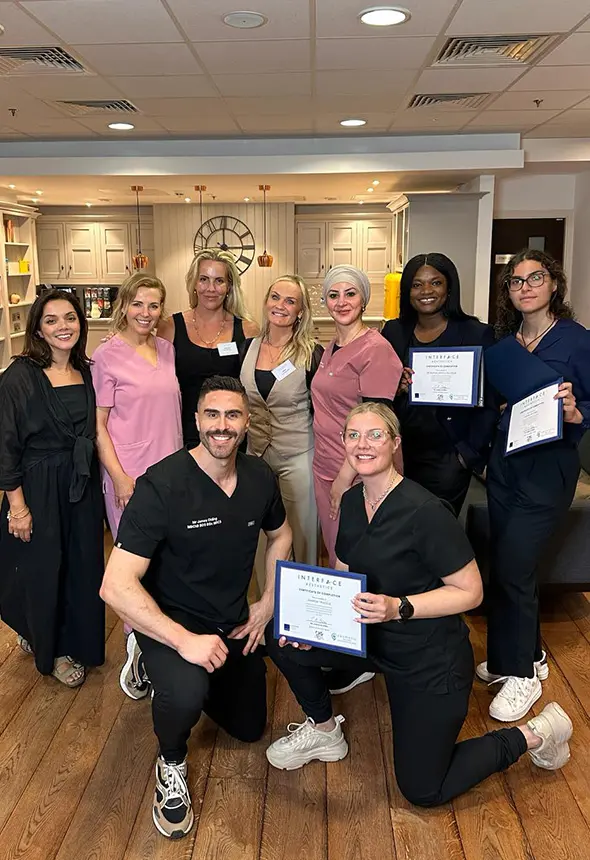
For practitioners who already have 2+ years of experience in injectables, two fast track options exist for the Level 7 Diploma:
How the Level 7 qualification can help you become an aesthetic practitioner
Becoming a competent aesthetic practitioner
The JCCP-approved Level 7 Diploma is a post-graduate level qualification which, importantly, is hands-on, with real model patients. A large part of the course consists of mentorship training days, where delegates will be injecting patients in a one-to-one setting, under the direct supervision of an experienced trainer. This level of supervised practical experience is what sets the PGDIP qualification apart from the one-day courses. Delegates will develop skills and confidence in delivering safely, and with the highest standards, injectable cosmetic treatments, integrating theory and practice. This combination will enable them to move into independent practice with confidence.
Another advantage of undertaking a regulated qualification, under the guidance of a Level 7 trainer, is that complication teaching can be covered in much greater detail. The recognition and management of complications, such as vascular occlusion, must form a central part of the training of any new practitioner, with the safety of our patients the number one priority.
Standardised theoretical content, multiple face-to-face training days and assessments designed to test this key area mean that aesthetic practitioners are able to feel more confident in independent practice following the Level 7 qualification.
As such, those practitioners will have a detailed and broad understanding of key principles underpinning safe and competent practice in medical aesthetics. Such a level of detail is impossible to obtain on one- or two-day courses. The main objective of any training should be to make practitioners feel confident and competent to move into independent practice. As with any career in Healthcare, competency is developed through practice and mentoring.
The JCCP-approved Level 7 qualification is the only qualification in aesthetics that combines elements of theory, practice, mentoring and assessments.
In addition to the Level 7 syllabus, theoretical understanding is tested via coursework assignments in the form of short answer questions (SAQs), ensuring there is a validated and regulated assessment to consolidate learning and understanding.
Level 7 diploma and employability
The Level 7 Diploma in Injectables was the first nationally accredited and regulated qualification of its kind and was born out of the growing concern over poor regulation within the sector, as highlighted in the Keogh Report (2013) and subsequent HEE guidance (2015). The Level 7 Diploma is OFQUAL-regulated, and delivered via Industry Qualifications, meaning that it is subject to rigorous external auditing and quality assurance measures. Aspiring aesthetics practitioners should consider the JCCP-approved Level 7 Diploma qualification if they want to pursue a successful career in aesthetic medicine.
The Level 7 Diploma involves building a verified treatment portfolio of 40 patients under expert supervision, which can be used as experiential evidence when applying for clinical roles in the industry. The theoretical material covered, ranging from cosmetic psychology to dermatology, as well as the formalised and regulated assessment process (including an OSCE), will also hold practitioners in good stead when moving into practice, either within the framework of another clinic, or independently.
Future-proof your aesthetic career with Interface Aesthetics
In addition to obtaining a nationally recognised qualification, it is important to consider the current direction of travel within the UK towards greater regulation within the aesthetics industry.
Complications are being brought into the spotlight due to a lack of regulations and poorly trained practitioners – there is a high number of non-medics practising in this unregulated industry. That’s why there is growing awareness by both the public and by the government that the present situation surrounding injectables is untenable. Moves by authorities within the UK such as that taken by the Scottish Government to regulate non-healthcare professionals providing aesthetic treatments should be seen as a sign of things to come, with the current vacuum being filled by governments stepping in.
Other areas of regulatory debate include the tightening of controls around the use of dermal fillers, with national media campaigns spearheaded by BAPRAS (British Association of Plastic, Reconstructive & Aesthetic Surgeons) and BAOMS (British Association of Oral & Maxillofacial Surgeons). Indeed, this subject was debated in parliament only recently, with further consultations ongoing in government.
The direction of travel towards greater regulation means that aesthetic practitioners must look to regulated training options to future-proof their careers. Choosing a regulated qualification, which has been created in conjunction with the regulatory bodies involved in drafting HEE guidelines, means Level 7 Diploma holders will be best placed moving forward as the industry continues to expand.
Interface Aesthetics puts practical training at the core of all courses. If you want to become an aesthetic practitioner, we highly recommend that you undertake the JCCP-approved Level 7 Diploma in Injectables.
- Training academy with the most expertise and hands-on training with live model patients.
- Guaranteed small group training designed and delivered by experienced practitioners who are Registered Healthcare Professionals with a strong emphasis in patient safety and a background in Facial Surgery.
- Ongoing support and networking opportunities as soon as you enter our training facilities.
- Extracurricular options if you want to pursue other areas of aesthetics (become a trainer, a speaker at Interface Expo or a researcher).
- Attendance at events.
- CPD accreditation.
- Access to exclusive discounts and offers from our trusted industry partners.
Contact us today if you want more information about our aesthetic training courses, available in London and in Manchester, or if you have questions about our interest-free payment plan options.
Course Recommendation
We aim to offer the best aesthetics training in the UK. Our cosmetic injectables courses for healthcare professionals are part of a structured award-winning training pathway in medical aesthetics.