Research
New Research: The Advancement-Rotation Principle in Chin Augmentation
Mr James Olding, Founding Director of Interface Aesthetics, published new peer-reviewed research proposing the first integrated framework for chin filler assessment in the Aesthetic Surgery Journal Open Forum.

By James Olding, MBChB (Hons), BDS (Hons), FRCS (OMFS) | Founding Director of Interface Aesthetics
Published in: Aesthetic Surgery Journal Open Forum | DOI: 10.1093/asjof/ojag110
I’m pleased to share that my latest paper, The Advancement-Rotation Principle in Chin Augmentation: A Preliminary Case Series, has been published in the Aesthetic Surgery Journal Open Forum – the official journal of The Aesthetic Society.
I led this research project, which brought together my two roles: NHS senior registrar in maxillofacial surgery, and Founding Director of Interface Aesthetics. The study itself spanned both spheres, involving colleagues and mentees from Interface Aesthetics alongside external experts in maxillofacial surgery and orthodontics, and represents a genuinely multidisciplinary approach to aesthetic medicine.
This isn’t the first time our team has taken this kind of multidisciplinary approach to improving patient outcomes and safety – at Interface Expo 2025, we held the first aesthetic medicine MDT on stage, tackling challenging cases such as these.
Why We Studied This
Chin augmentation treatment with injectable filler is one of the most common requests in aesthetic medicine, but it’s also one of the most frequently mismanaged. Even experienced practitioners often assess the chin in one dimension – how far forward to bring it.
What has been missing from the literature is a framework that accounts for why two patients who look similarly retrusive in profile can need completely different treatment approaches.
That gap comes down to jaw growth pattern – something surgeons and orthodontists think about constantly, but which hasn’t been properly translated into aesthetic medicine until now.
I wanted to bring the perspective I’ve built over twenty years of surgical training – as a Fellow of the Royal College of Surgeons in Oral and Maxillofacial Surgery, a senior registrar in maxillofacial surgery, and a dually qualified doctor and dentist – to ask how surgical principles used routinely in orthognathic planning could be applied to non-surgical aesthetics.
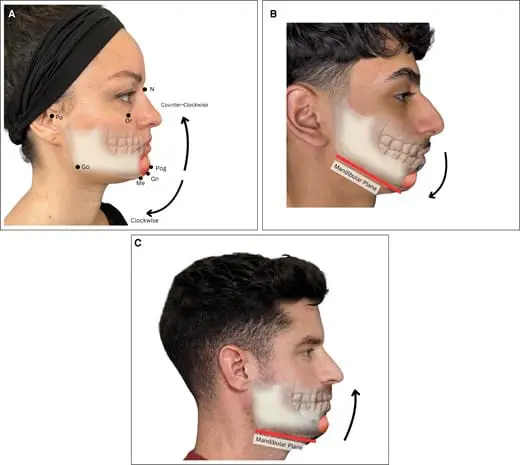
Standardised lateral views.
- (A) Female, 39 years old. Used for illustrative purposes. Soft tissue cephalometric points: Pog – Pogonion; Gn – Gnathion; Me – Menton; Go – Gonion; Po – Porion; Or – Orbitale; N – Nasion;
- (B) Male, 20 years old. Illustration of a high mandibular plane angle with clockwise rotation.
- (C) Male, 39 years old. Illustration of a low mandibular plane angle with counter-clockwise rotation.
What the Paper Proposes
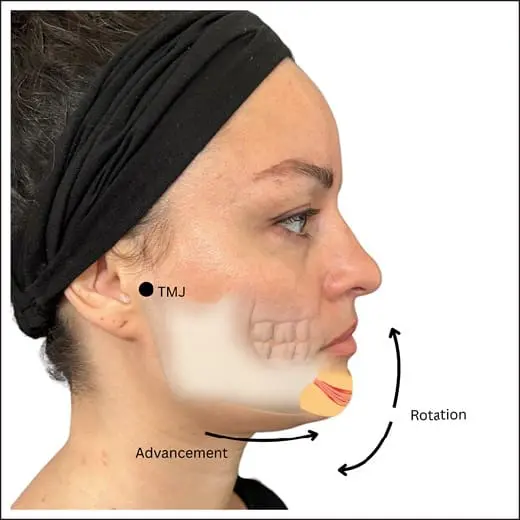
Working with a multidisciplinary team spanning oral and maxillofacial surgery, orthodontics, and aesthetic medicine, we set out to build a bridge between those fields. The paper introduces what we call the advancement-rotation principle: the idea that every chin filler treatment involves two linked variables – how far you bring the chin forward, and which way you rotate it – and that getting the rotation right depends on identifying a patient’s underlying jaw growth pattern.
This is where the paper adds a fourth dimension to how we think about the lower face. The key reference point is the mandibular plane angle – a measure used routinely in orthodontic and orthognathic surgical planning to describe a patient’s pattern of craniofacial growth and development, as either high-angle or low-angle. This angle has a direct impact on facial profile, jawline behaviour, and the appearance of the chin and jaw muscles – and, in turn, whether filler should be placed deep or superficially, and with a cannula or needle.
The practical innovation is that this assessment doesn’t require X-rays or specialist equipment. It can be done from a single standardised profile photograph, taken on an ordinary smartphone, by tracing two reference lines against the jawline. We illustrate the approach through a limited case series: one surgical case, contributed by one of my senior surgical mentors, alongside two of my own non-surgical cases, treated using Juvéderm Volux and Juvéderm Voluma respectively in the deep and superficial planes – one in a high-angle patient, the other in a low-angle patient – each achieving a harmonious result appropriate to their underlying growth pattern.
Case 1 – Non-surgical: high angle
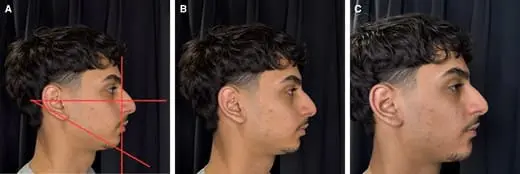
Male, 20 years old.
- (A) Intersection of the TH and MP lines anterior to the occiput indicates a high angle presentation.
- (B) Pretreatment.
- (C) Immediately posttreatment. Treatment provided: 1 mL Juvederm Volux with Lidocaine (VYC-25L Hyaluronic Acid Filler) (supraperiosteal at Gnathion), 2 mL Juvederm Voluma with Lidocaine (VYC-20L Hyaluronic Acid Filler) (superficial at Labiomental crease and Gnathion), 1 mL VYC-25L (anterior mandibular border to Menton in subcutaneous plane). A total of 4 mL over 1 session.
Case 2 – Non-surgical: low angle
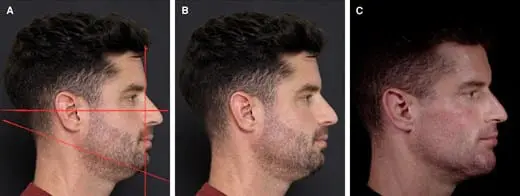
Male, 39 years old.
- (A) Intersection of the TH and MP lines posterior to the occiput indicates a low angle presentation.
- (B) Pretreatment.
- (C) Two months after first treatment, immediately after second treatment. Treatment provided: 2 sessions, 2 months apart, with each treatment consisting in 2 mL VYC-25L (superficial at labiomental crease and gnathion), 2 mL VYC-25L (anterior mandibular border to Menton in subcutaneous plane). A total of 8 mL over 2 sessions.
Why It Matters for Interface Aesthetics Training
This is precisely the kind of interdisciplinary, evidence-led thinking we teach across the Level 7 diploma in aesthetics curriculum: that safe, effective injectable practice depends on understanding the skeletal and developmental anatomy underneath the skin, not just injection technique in isolation.
We’ve already incorporated this framework directly into our teaching – from Foundation-level training through to our advanced masterclasses, including our dedicated Lower Face Contouring Course – giving delegates a genuinely evidence-based, unique approach not taught elsewhere in aesthetics education.
I feel strongly that genuine authority and leadership in this field have to be backed by an evidence base – by publications and research, not just by a stated amount of training delivered. That’s why I’m proud that this research was produced together with Interface Aesthetics colleagues as an official publication, alongside external multidisciplinary experts we continue to collaborate with. It reflects the standard we hold ourselves to: that leaders and educators in aesthetic medicine should be the ones driving improvements in standards and outcomes, not simply following them.
Reference
Olding JA, Messiha A, Karst FW, Kulik N, Chaer Z, Naini FB. The Advancement-Rotation Principle in Chin Augmentation: A Preliminary Case Series. Aesthetic Surgery Journal Open Forum. 2026;8:ojag110.
Read the full paper: https://doi.org/10.1093/asjof/ojag110
The paper is published open access and is free to read in full via the link above. Lead author James Olding’s affiliation to Interface Aesthetics is named directly in the publication.
About the author
James Olding is the Founding Director of Interface Aesthetics and an ST7 Oral and Maxillofacial Surgery registrar. He holds MBChB (Hons), BDS (Hons) and FRCS (OMFS), and his research is peer-reviewed and indexed on PubMed. ORCID: 0000-0003-2936-5022